Black Friday week
📄 Digital book in PDF · read it on your phone or print it
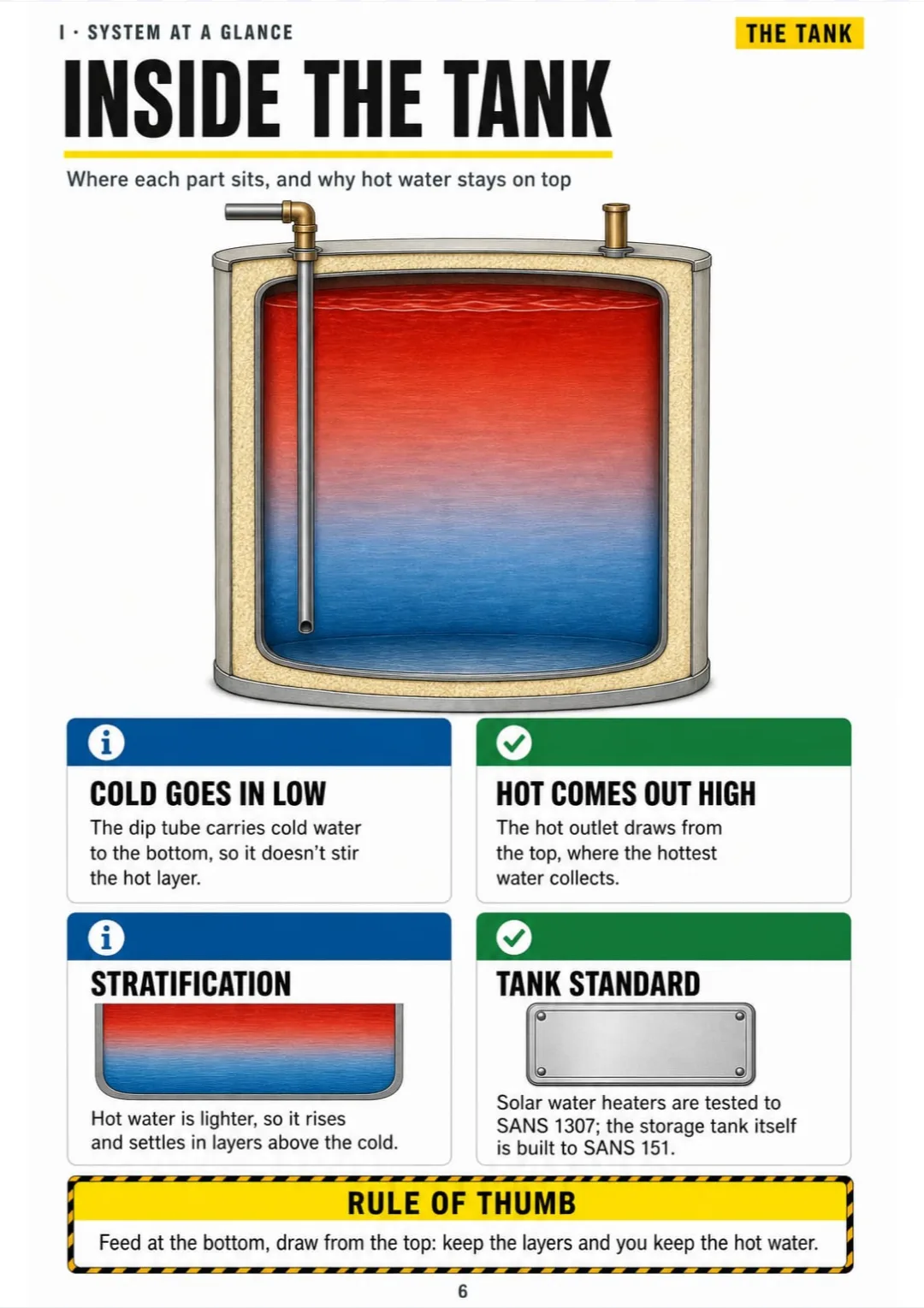
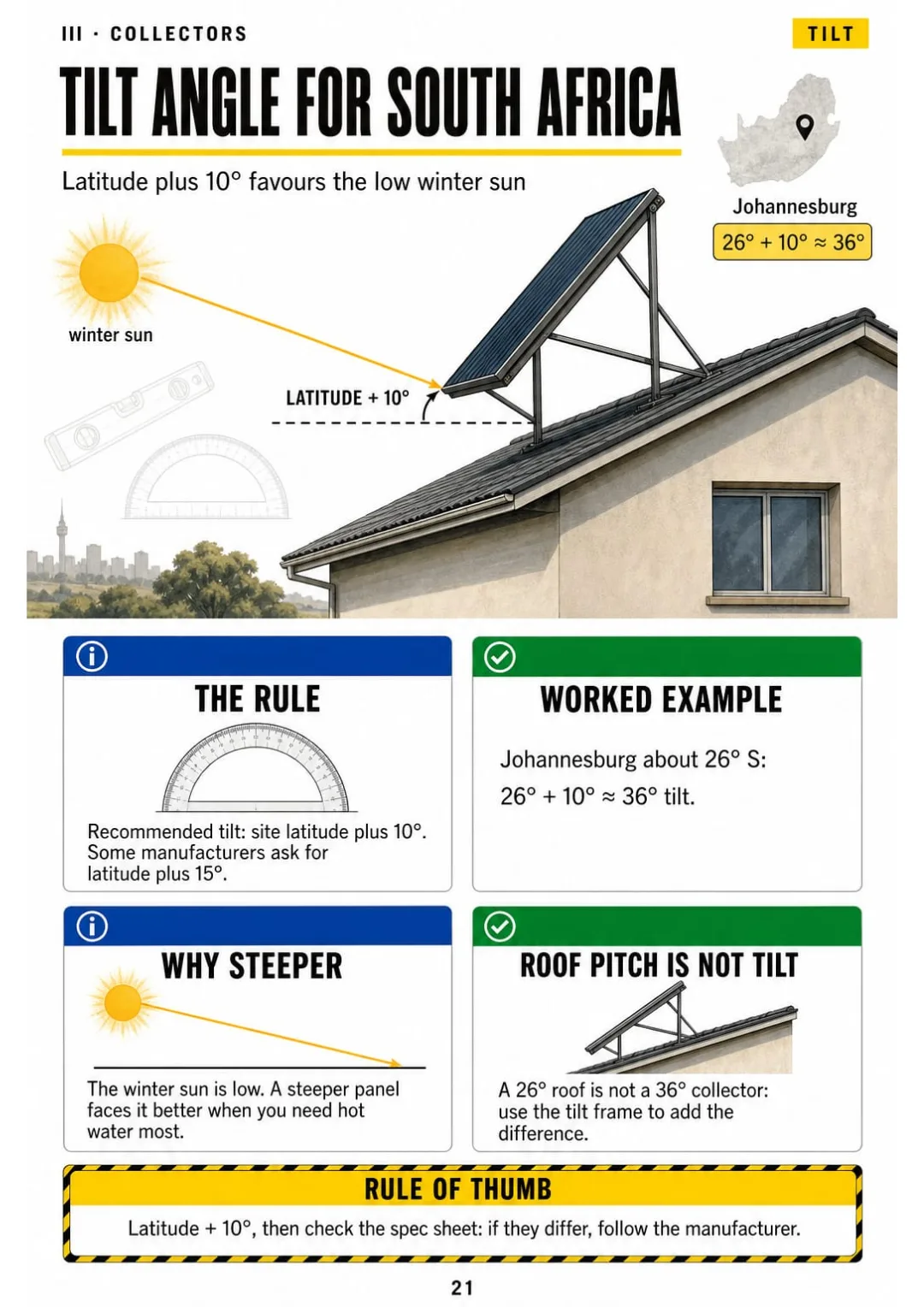
The tank inside out, the valve line-up, PCV ratings, collector tilt, thermosiphon vs pumped, differential controllers, the heat pump cycle, commissioning and fault-finding flow charts. Every topic has its own page: the drawing first, then what you need to remember. 67 illustrated pages.
🔒 Secure checkout · PDF by email · 30-day guarantee
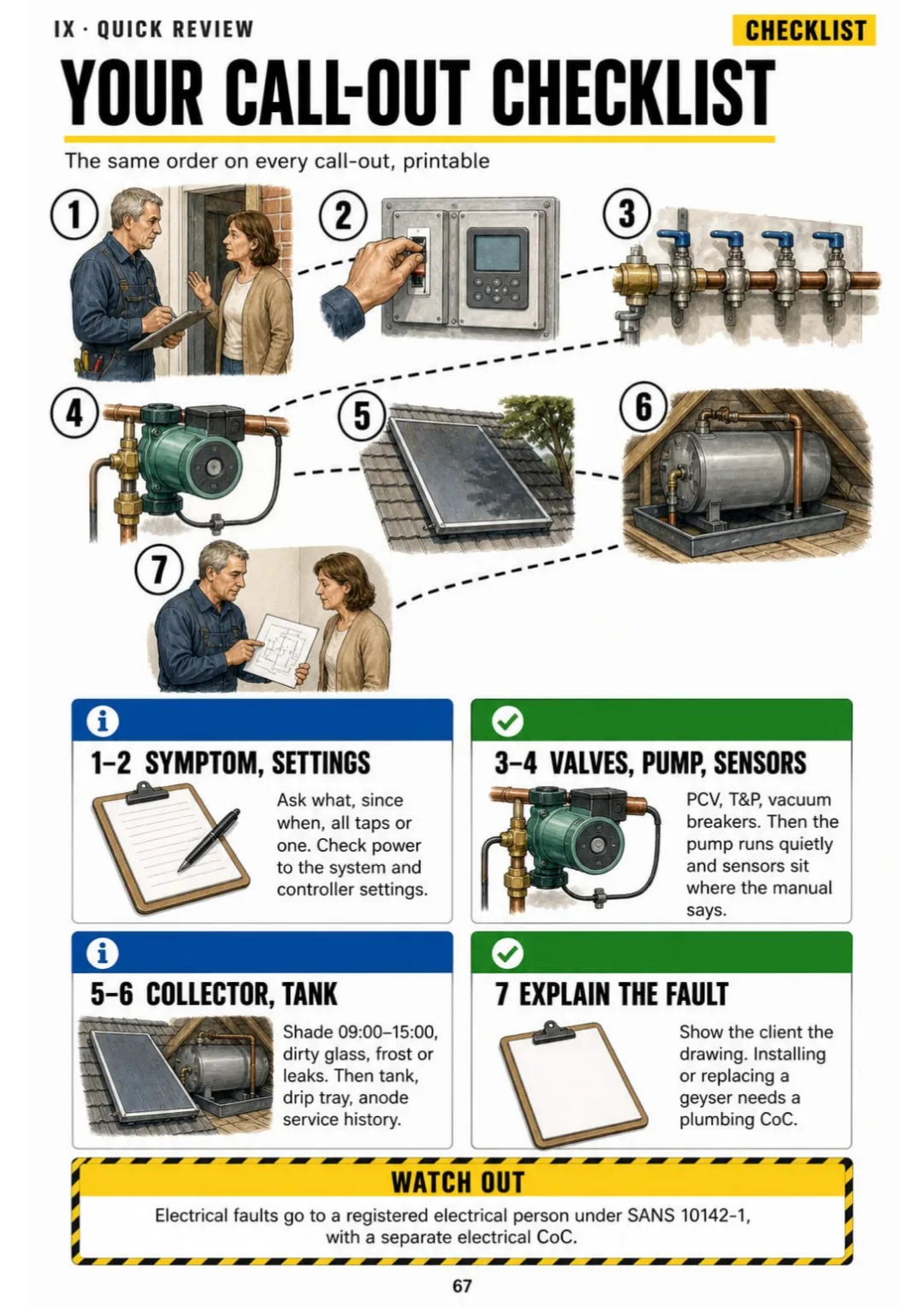
Each page has one big drawing and a box with the numbers, settings and steps you need to know:


Swipe to see more →
These are real pages from the book. The table of contents is the full one: 9 parts and 63 topics.
You're up in the roof space with a new high-pressure solar geyser, the cold supply pipe in your hand, and the client asks why it needs so many valves.
You know every valve by sight. But the order is in the manufacturer's manual, spread over three paragraphs and a note at the bottom, and the next brand words it differently.

In the book the valve line-up is one page: seven valves drawn on the cold side and the tank, numbered 1 to 7 — isolating valve, PCV, non-return, expansion relief, vacuum breakers, T&P and drain cock.
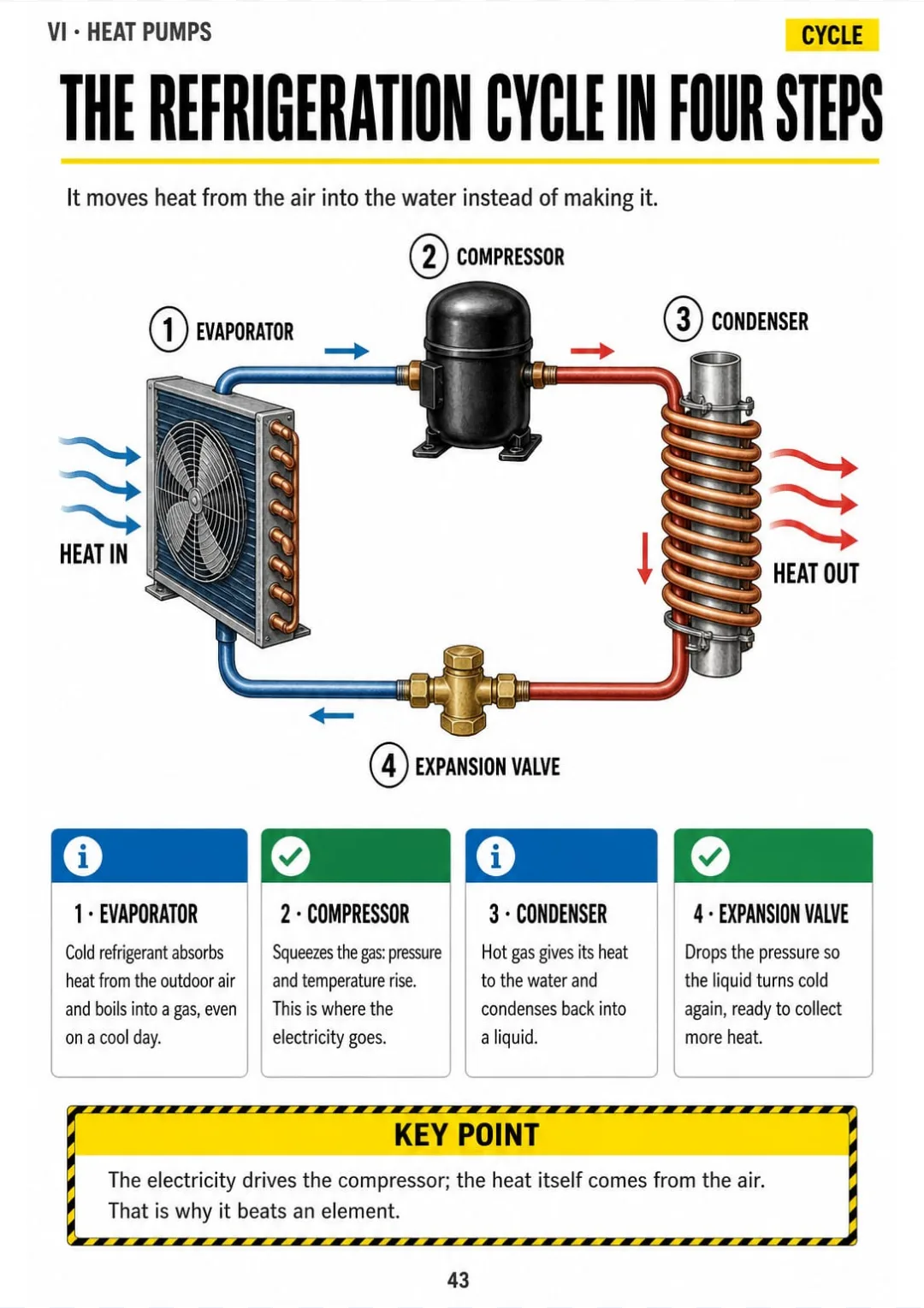
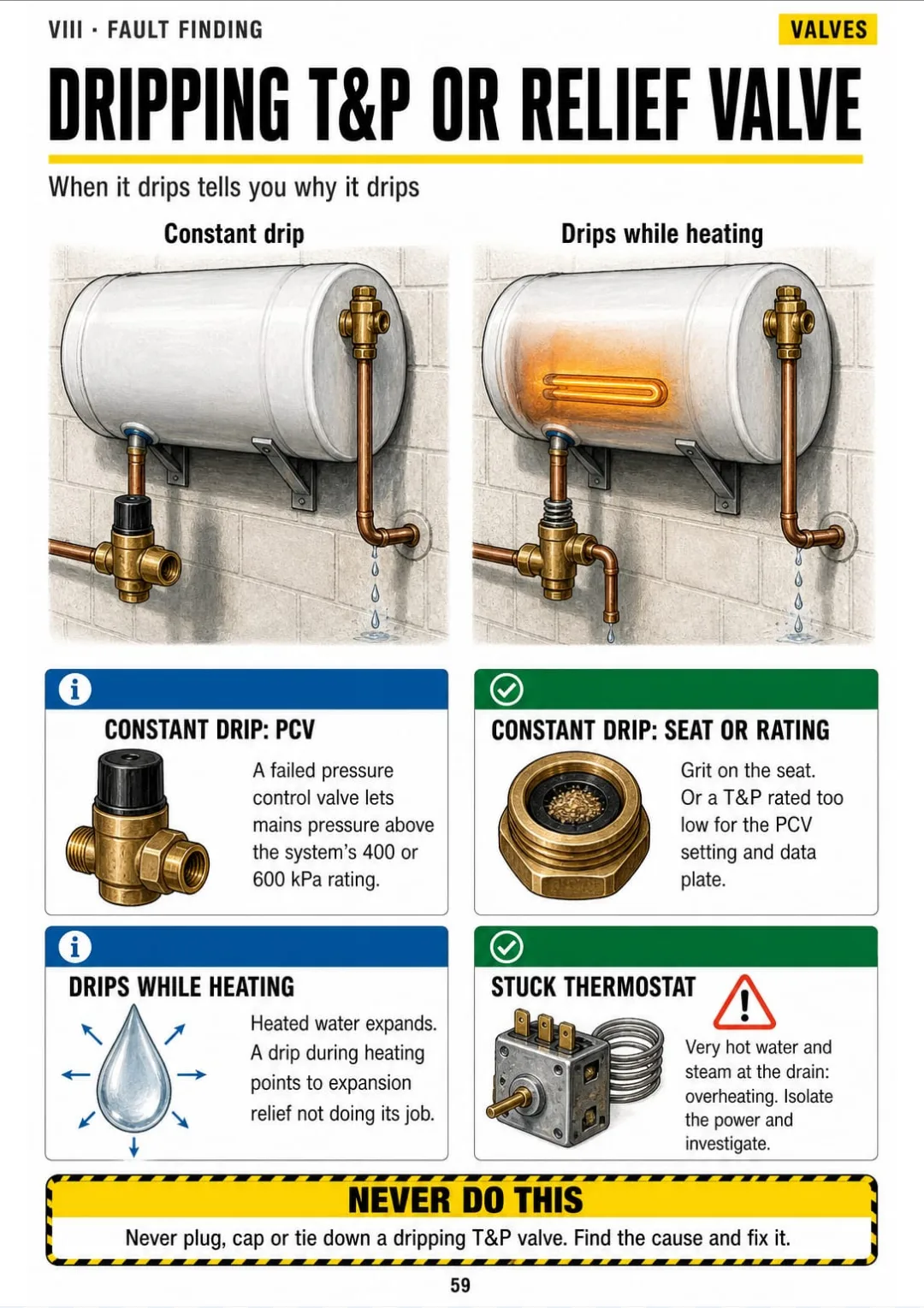
The same goes for the tilt angle, the commissioning walk, the refrigeration cycle, the dripping T&P and the lukewarm-in-winter chart: each one has its own page.
You see the order, you fit it the same way on every job, and you can show the client the drawing without going back to the manual.

The system at a glance, choosing and sizing, collectors and roof mounting, valves and pipework, pumps and controllers, heat pumps, commissioning and maintenance, fault finding and a quick review: 67 pages, all illustrated.
Think of it this way:
The client calls: the T&P valve on their solar geyser has been dripping since Sunday. You're in front of the tank and you have to decide whether it's the pressure, the temperature or the valve itself.
You open the page on the dripping T&P and see a yes/no flow chart drawn next to the valve: a constant drip points to the PCV, the seat or the rating; a drip only while heating points to expansion or the thermostat.

Same with the valve line-up, the tilt angle for your city, the heat pump cycle, the commissioning walk and lukewarm water in winter: each one on its own page.
Solar Geyser & Heat Pump Illustrated is 9 parts and 63 topics, all drawn, and it ends with the frequent installation mistakes, the whole system on one page and your call-out checklist.
What you see drawn, you don't have to memorize.
The whole system in one drawing, inside the tank, element and thermostat, the anode, low vs high pressure, direct vs indirect and thermosiphon vs pumped.
Litres per person, from litres to square metres of collector, flat plate vs evacuated tubes, solar or heat pump, retrofit or new tank and how to read a spec sheet.
Facing north, the tilt angle for South Africa, the shade check, mounting on tiles, IBR and flat concrete roofs, Highveld frost and stagnation.
The valve line-up in order, the PCV at 400 or 600 kPa, the T&P, vacuum breakers, discharge pipes, pipe sizes, insulation and the tempering valve.
The circulation pump, the differential controller logic, sensor placement, timer and element backup, settings to check and where your job stops on the electrical side.
The refrigeration cycle in four steps, COP without the maths, split vs all-in-one, placing the outdoor unit, connecting to the tank, condensate, defrost and settings.
Filling and purging air, filling a glycol loop, leak, pressure and temperature checks, the paperwork you hand over, the yearly service and hard water.
How to read the flow charts, then no hot water, lukewarm in winter, a dripping valve, the pump, cold at night, a heat pump not heating, and rust, smells and noises.
The frequent installation mistakes, how to explain the system to the client, the whole system on one page and your call-out checklist.
At the end of the book: Fault-finding flow charts, the frequent installation mistakes, the whole system on one page and a call-out checklist.


Practise fault finding on paper: read the symptom, follow the flow chart and check your answer, so the next dripping valve or lukewarm tank doesn't catch you guessing.

The key valves, litres per person, collector areas, heat pump clearances and controller settings on a few printable cards to keep in the van.
📄 This is a digital PDF book sent to your email: nothing is printed or shipped.
PDF by email: We email you Solar Geyser & Heat Pump Illustrated as a PDF, together with the two free books. It's a single payment: no installments, no extra charges.
You've fitted electric geysers for years and clients now ask for solar. The book puts collector, tank, valves, pump and controller in one order you can follow.
You know the roof and the inverter. The book adds the tank, the valve line-up, the controller and where the plumbing starts, each on one page.
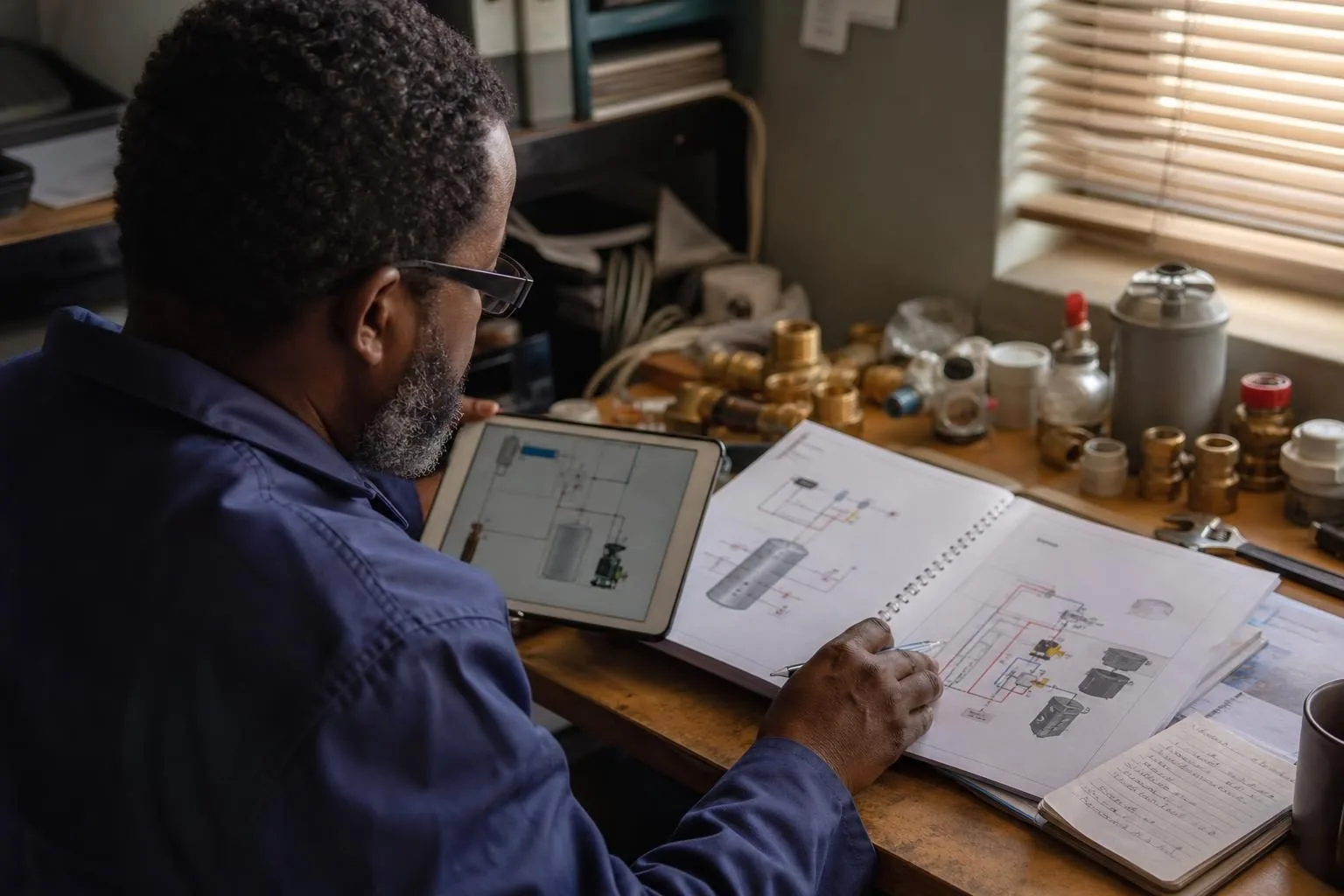
Faults become yes/no flow charts, and you can show the client the drawing of their own system to explain what you found.
📄 This is a digital PDF book sent to your email: nothing is printed or shipped.
Try Solar Geyser & Heat Pump Illustrated for 30 days, bonus books included.
We refund everything if the file won't open, if the book isn't what you see here, if you were charged twice or if the email doesn't arrive. Just email us.
You pay once. No subscriptions.
Yes. It doesn't teach plumbing from scratch: it puts solar geysers and heat pumps in one order (valves, collectors, controllers, the heat pump cycle, commissioning and faults) so you see the whole system at a glance. If you install PV or own a solar geyser, it also helps you understand what's on the roof.
It's written for South African installs: collectors facing north, tilt angles for SA cities, tile, IBR and flat concrete roofs, Highveld frost and hard water. It's checked against current South African standards for water heating, such as SANS 10106 and SANS 10254, and against manufacturers' installation instructions. All units are metric: kPa, litres, mm and °C.
No. It's an independent illustrated guide. It isn't issued, approved or endorsed by the SABS, the PIRB, any industry body or any manufacturer. It doesn't give you a certificate, a registration or CPD points, and it doesn't replace the CoC process: it's a reference to fit and fault-find in the right order.
No. It puts the manual in order; it doesn't replace it. Always follow the instructions for the unit you're fitting. Electrical work stays with a qualified, registered electrician, and refrigerant work on split heat pumps with a technician authorised to handle refrigerants. The book shows where your job stops.
No. The 25 fault scenarios in the workbook are written for this book, so you can practise the flow charts on paper.
The book and the 2 gifts arrive as PDFs by email, at the address you enter when you pay.
No. It's a one-off payment.
Yes. Print it at home or at a print shop and keep it in the van.
You have 30 days. We refund everything if the file won't open, if the book isn't what you see on this page, if you were charged twice or if the email doesn't arrive: just email us.
No more rereading manuals that don't stick.
The valve line-up: you see it drawn, and that's it.
You arrive at every call-out knowing where everything is.
Drawings make studying faster.
The book is right below.
One-time payment: US$ 27 · Guarantee: 30 days · PDF by email
YES, I WANT SOLAR GEYSER & HEAT PUMP ILLUSTRATED FOR US$ 27📄 This is a digital PDF book sent to your email: nothing is printed or shipped.